Data Center Thermal Intelligence
Rack-level AI monitoring that detects thermal anomalies before they become outages. Purpose-built for the ambient conditions and compliance requirements of Saudi data centers.
Key Performance Metrics
Measured outcomes from production deployments across Saudi facilities.
Real-time rack-level temperature monitoring with high precision — far beyond legacy building management sensor accuracy.
AI setpoint optimization targets meaningful cooling cost reductions. Platform designed to deliver results after deployment.
From anomaly detection to operator notification. AI models catch thermal deviations before they become incidents.
Feature Deep-Dive
Every capability is engineered for the operational realities of Saudi data centres and logistics networks.
Real-Time Rack-Level Monitoring
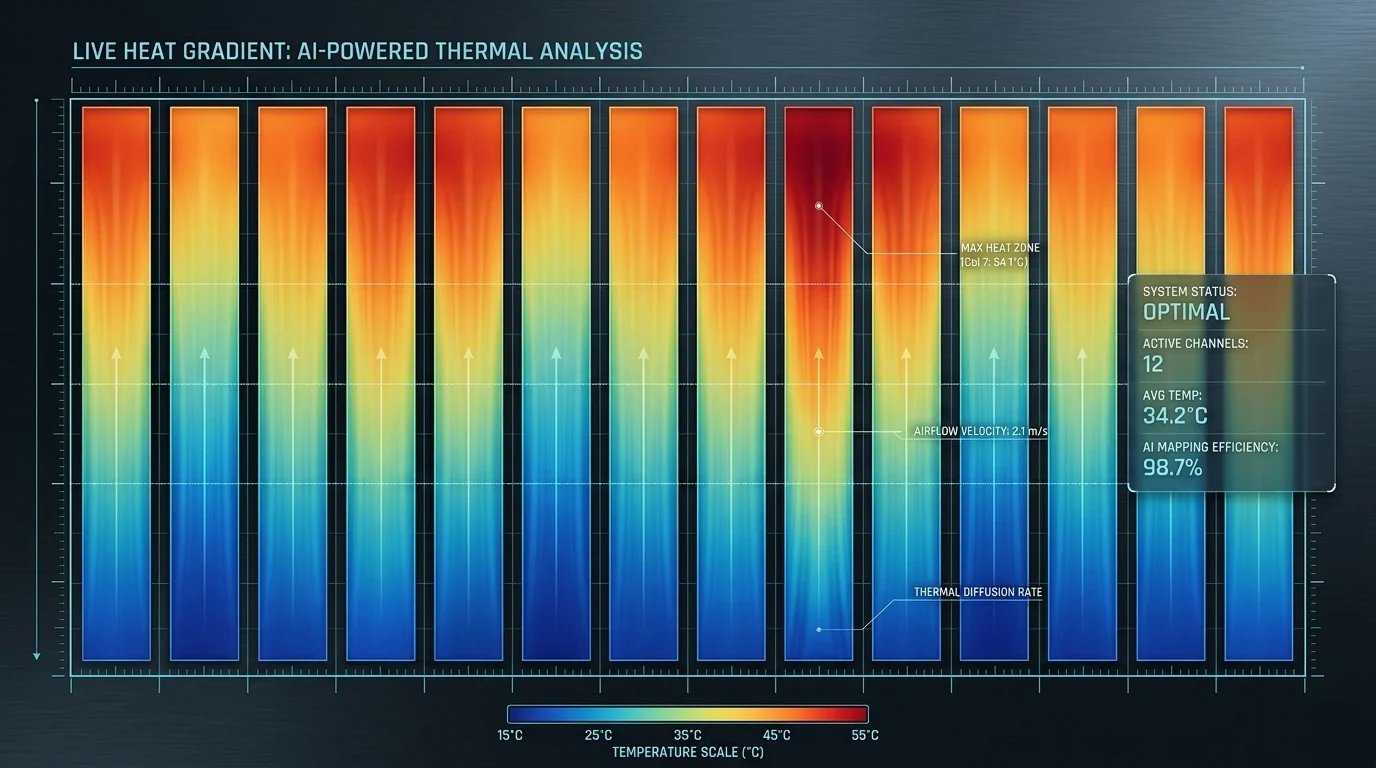
Deploy calibrated temperature sensors at every rack position — not just room-level averages. A live dashboard gives your operations team instant visibility into hot spots, airflow patterns, and thermal gradients across the entire data hall. Configurable threshold alerts route directly to your on-call team with contextual diagnostics, eliminating hours of manual investigation.
AI Anomaly Detection
Machine learning models trained specifically on Saudi climate data account for the extreme ambient temperatures and humidity profiles found in Saudi facilities. The system learns your baseline thermal fingerprint and flags deviations with explainable alerts — identifying whether an anomaly stems from a failed CRAH unit, a blocked blanking panel, or an unexpected workload spike.
Airflow Optimization
CFD-informed recommendations guide your facilities team on containment improvements, blanking panel placement, and airflow management without requiring an expensive physical simulation. The platform correlates sensor data with rack utilization to surface high-value, low-cost interventions that yield immediate PUE improvements.
Capacity Planning
Thermal capacity modeling integrates with your DCIM data to simulate the impact of new rack placements and density changes before they're executed. Avoid expensive reactive moves by understanding the thermal consequences of expansion decisions ahead of time — critical for colocation facilities managing multi-tenant SLA obligations.
How It Works
A structured, low-disruption deployment process designed to integrate with your existing infrastructure.
Install Sensors
Wireless temperature and airflow sensors are deployed at every rack inlet and outlet. Installation is non-disruptive and typically completed within one business day for a 100-rack facility.
Connect to BMS
The Tabrid.ai gateway integrates with your existing Building Management System via standard protocols (BACnet, Modbus, MQTT). No rip-and-replace required.
AI Learns Patterns
Over the first 14–21 days, the ML models establish your facility's thermal baseline, accounting for workload cycles, ambient conditions, and seasonal variation.
Continuous Optimization
The system moves from monitoring to active optimization — issuing setpoint recommendations, generating capacity reports, and improving its models with each new data point.
Integration Points
Connects natively to your existing BMS, DCIM, and ERP systems with minimal configuration.
See Data Center Thermal Intelligence in Action
Schedule a personalised demo and discover how this module integrates with your existing infrastructure to deliver measurable results.
Request a DemoNo commitment required. Typical demo is 30 minutes.